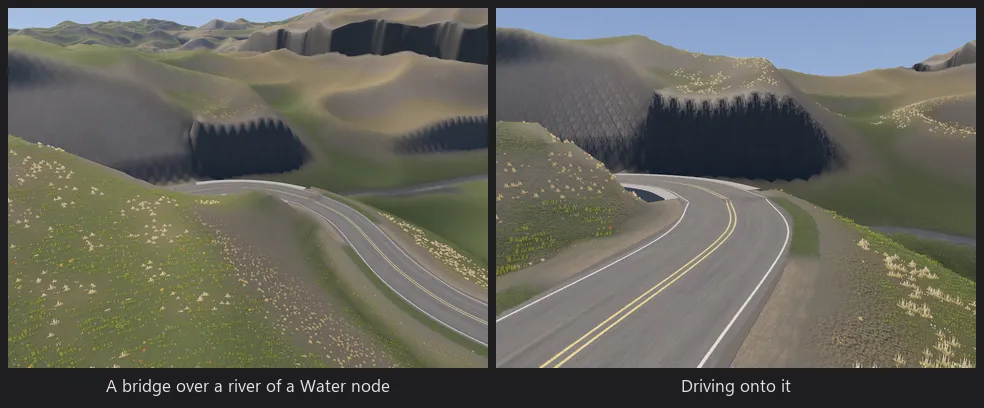
Bridges and water
Where the ideal line of a road rides high above the ground (across a gorge or a deep valley), or crosses water, the Road Network builds a bridge instead of a huge embankment. The terrain under the bridge is left as it was, and the bridge deck is exported as a BeamNG MeshRoad, its top flush with the road.
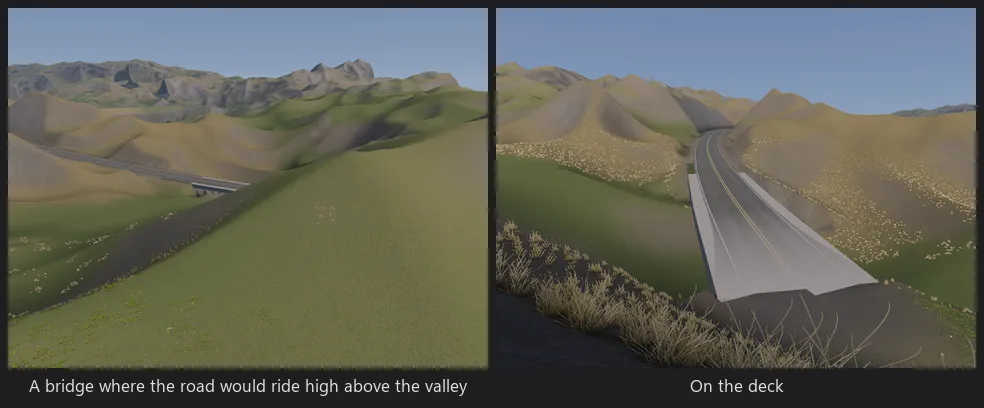
Bridge spans show in cyan on the road lines in the editor’s 3D view.
When a road becomes a bridge
Section titled “When a road becomes a bridge”The node first works out the profile the road would like (smoothed and grade-limited), then looks for stretches where that profile is more than Bridge Min Clearance above the ground, or over water. Each stretch is extended by Bridge Abutment at both ends, so the deck lands on solid ground, and becomes a straight bridge between them, unless:
- it is longer than Bridge Max Span: the road keeps an embankment instead,
- it is within 30 m of the road’s junction with another road.
| Setting | |
|---|---|
| Bridges | Builds bridges at all. Off, every crossing is an embankment. |
| Bridge Min Clearance | How high above the ground the road must ride to get a bridge (6 m). Raise it for fewer, larger bridges. |
| Bridge Max Span | The longest bridge (250 m). |
| Bridge Abutment | How far each bridge reaches past the gap onto the ground (6 m). |
| Bridge Water Clearance | How high the deck stays above water (3 m). |
| Bridge Deck Depth | The thickness of the exported deck. Export only. |
| Bridge Top / Bottom / Side Material | The deck’s materials. Export only. |
Rivers and lakes
Section titled “Rivers and lakes”With a Water node before the Road Network, the routes avoid water (see Water Crossing Cost), and where a road does cross a river or a lake:
- it gets a bridge whose deck stays Bridge Water Clearance above the water, or
- where no bridge can be built (too long, too near a junction, or Bridges off), a causeway: the road is raised 1 m above the water on an embankment.
A road is never under water.