
Branches
Branch generators make the wood: trunks, limbs, boughs, twigs and roots (and Fronds, Knots and Roots, which are Branches with other defaults). Each one works in three steps:
- Generation places nodes on every node of the parent generator.
- Spine grows each node as a line in space: length, angle, gravity, noise, curl, forces.
- Skin wraps the spine in a mesh: radius and taper, the joint with the parent, bark relief, texture mapping and the triangles per detail level.
The pictures on this page were taken in the editor’s Real view, mostly on the beech template with its leaves switched off. Each row changes one setting and keeps everything else as it is. Every setting is listed in the reference.
Generation
Section titled “Generation”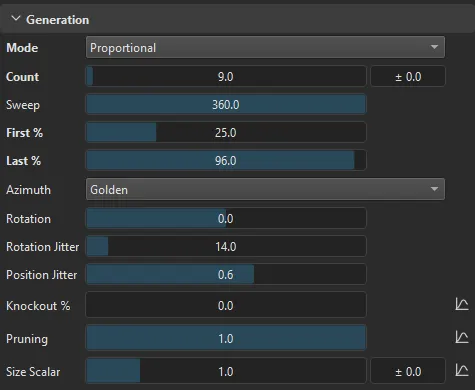
Count and Mode
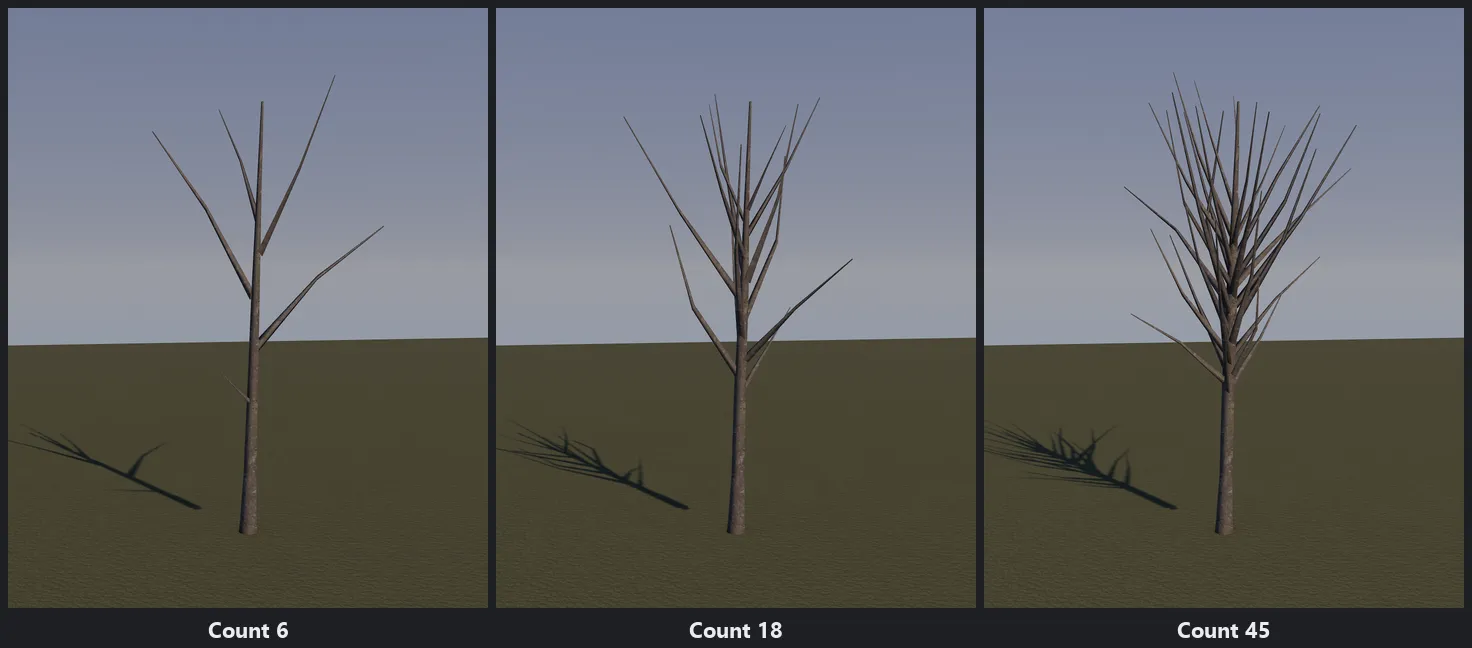
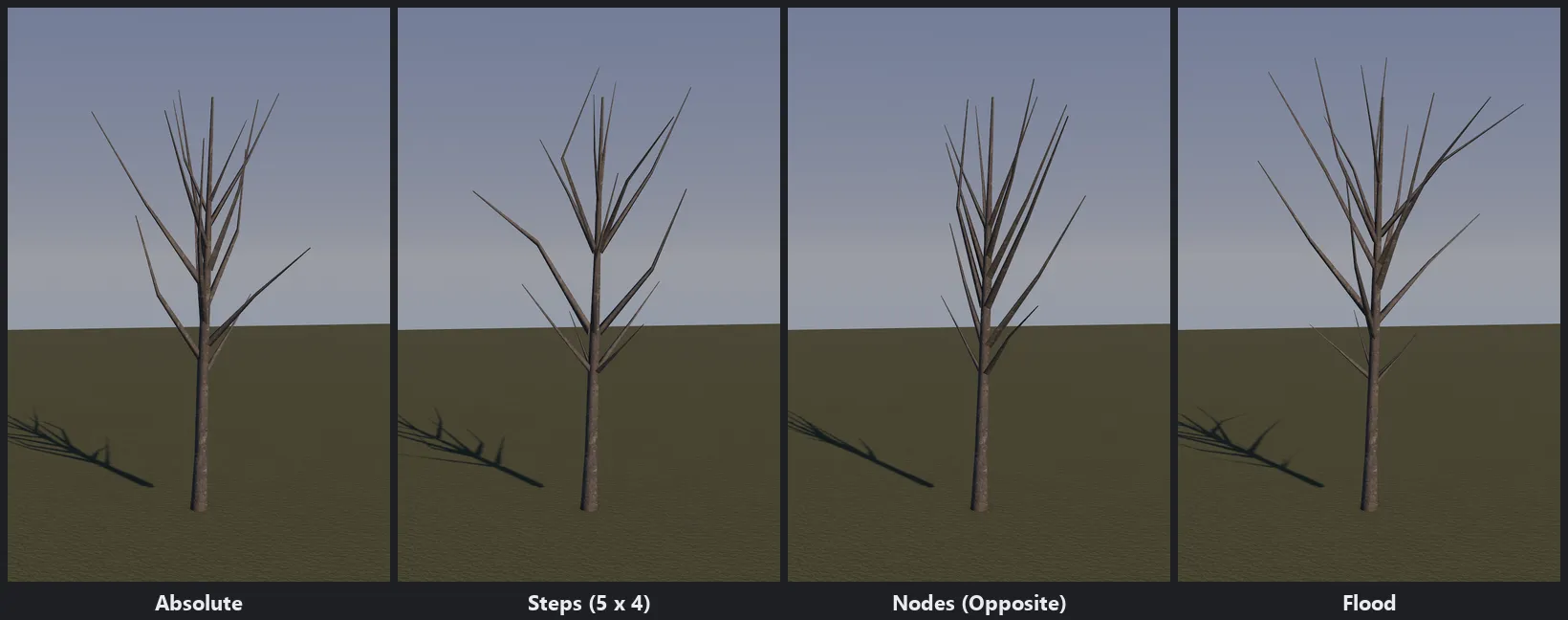
Section titled “Count and Mode”Mode decides how nodes are placed on each parent node, and Count how many (in most modes).
| Mode | Places |
|---|---|
| Absolute | Count nodes on every parent node, spread between First and Last. |
| Proportional | Count on parent nodes at least 60 % as long as the longest, fewer on shorter ones. Short boughs get few twigs. |
| Steps | Steps whorls of Per Step nodes each. |
| Phyllotaxy | Count nodes on the golden angle (137.5° apart), like leaves on a shoot. |
| Nodes | A node every Internode metres, counted down from the Last boundary, arranged like real shoots by Arrangement: Spiral, Distichous (alternating in one plane: beech and elm twigs), Opposite, Decussate (pairs turned 90°: maple, ash) or Whorled (Per Node around each node: pines and firs). Stagger turns every other whorl by half a slot, and Spiral adds a turn from node to node. |
| Interval | Per Node children every Interval metres. |
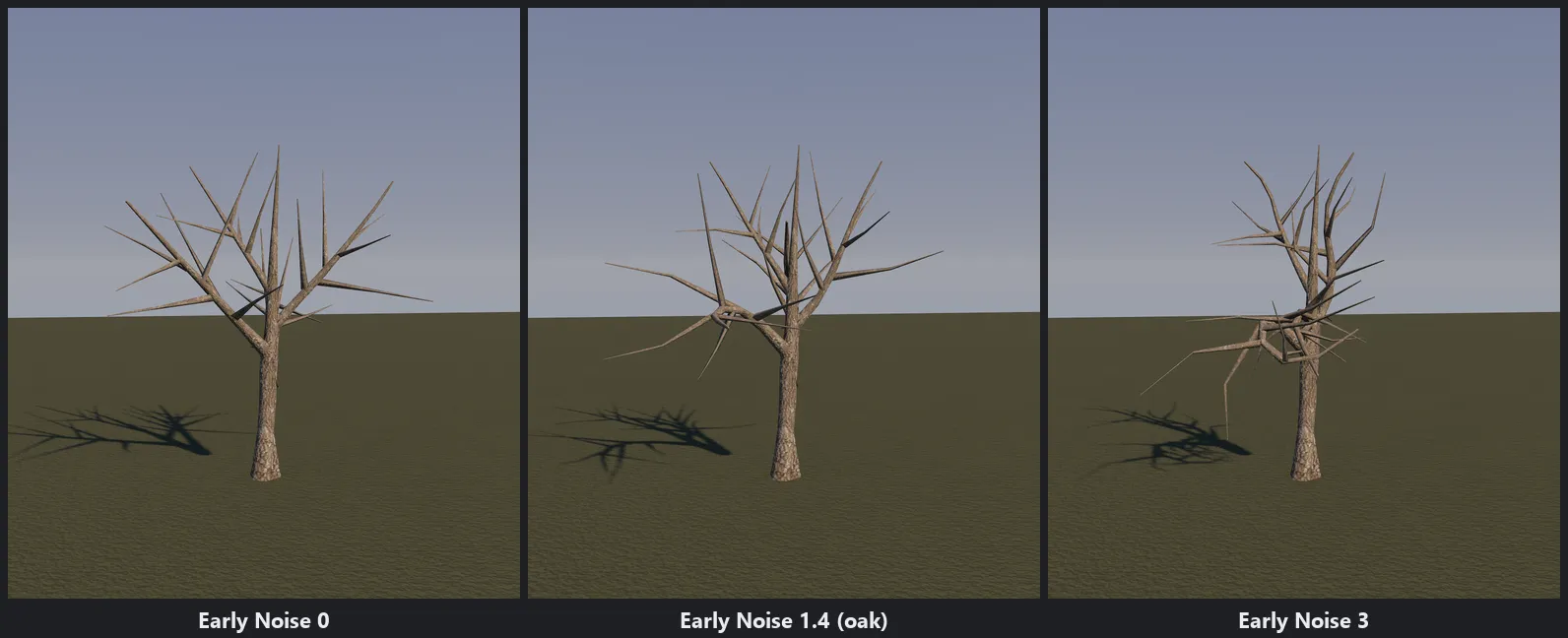
| Bifurcation | Children where the parent’s spine kinks, carrying on in its old direction: sympodial growth, like an oak’s crooked limbs. The parent needs kinks (Early Noise or Jink). Kink Angle is how sharp a kink must be, Kink Spacing % how close two may be, Kink Align puts them in one plane. |
| Flood | Count nodes at random spots. |
| Parent | Count nodes at the parent’s base: trunks on the Tree root, stems from a stump. |
| Tip | Count nodes at the parent’s tip: forks, leader shoots, tip leaves. |
Where on the parent
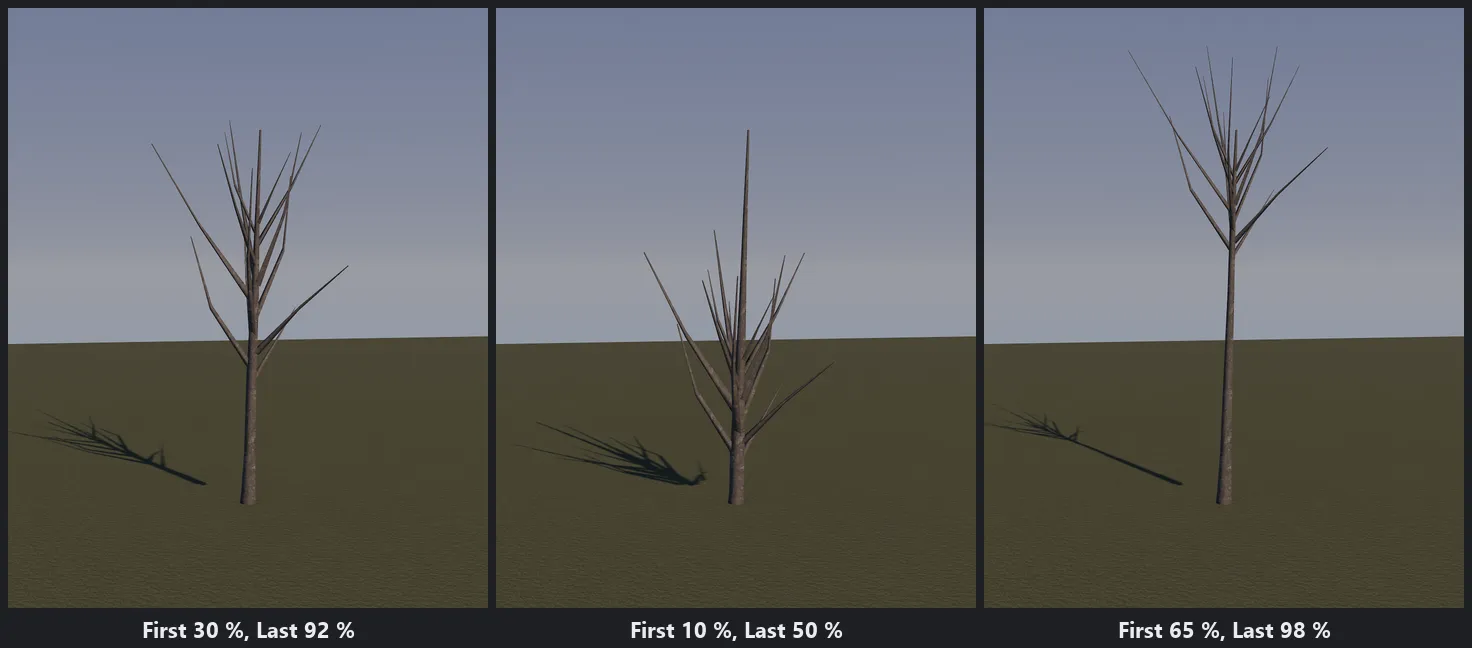
Section titled “Where on the parent”First % and Last % limit where nodes grow along the parent. They also set the range of the generator’s parent curves.
Around the parent
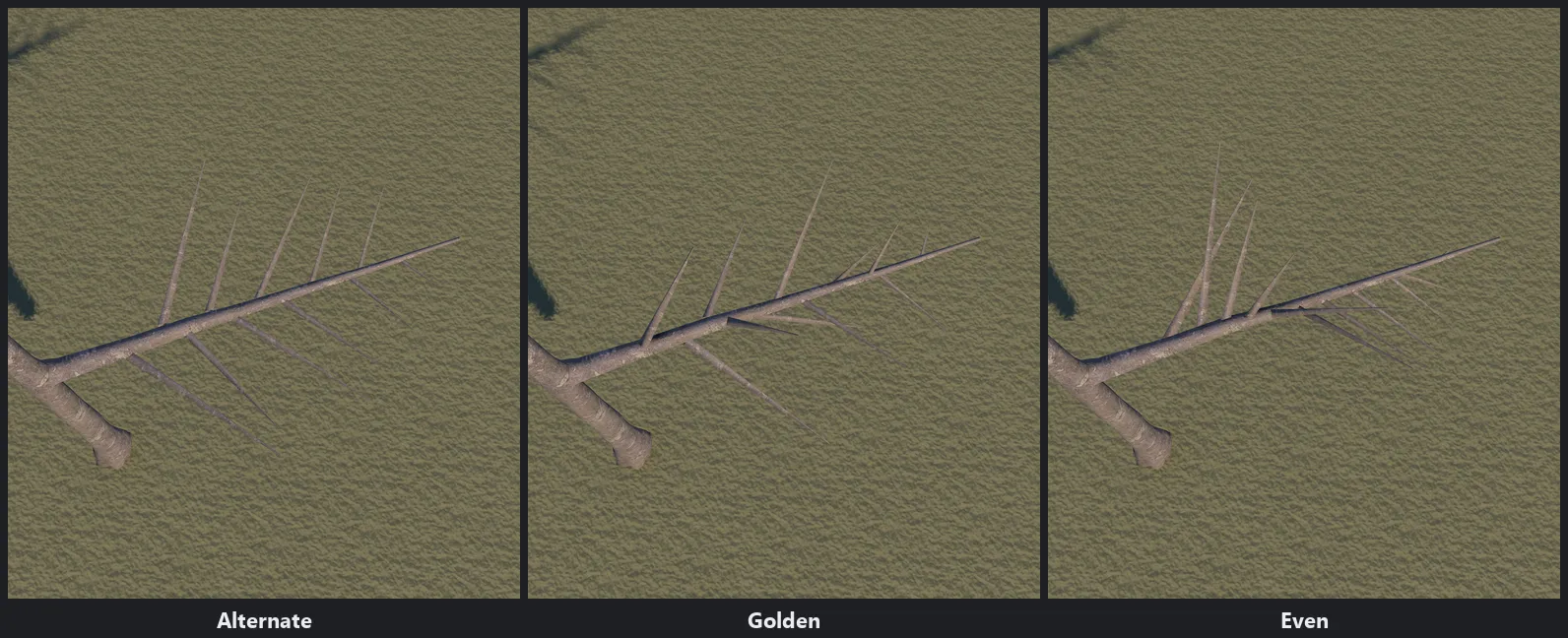
Section titled “Around the parent”Azimuth sets the direction around the parent: Golden (137.5° apart), Alternate (left and right in a flat fan, for twigs), Even, or Random. Rotation turns them all, Rotation Jitter turns each one a random amount, and Position Jitter shifts each along the parent by a share of the spacing.
Thinning and scaling
Section titled “Thinning and scaling”- Knockout % removes that share of the nodes at random. With its curve it thins part of the parent.
- Pruning removes nodes where the value (times its curve) is under 0.5: draw a curve that dips to 0 to cut nodes out of one part of the parent.
- Size Scalar scales the nodes’ length and radius, often with a parent curve (smaller towards the top).
Length and angle
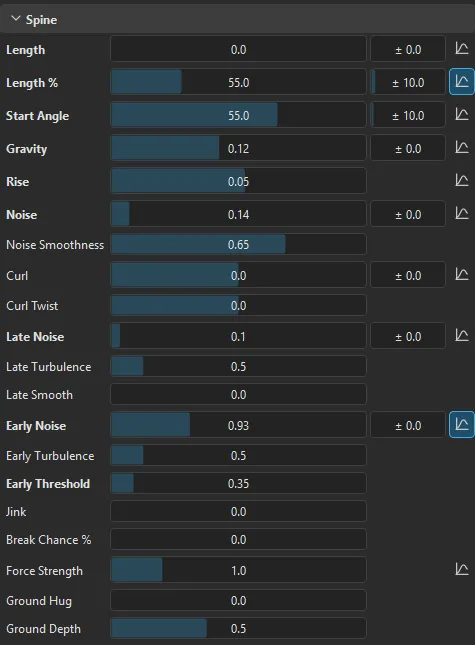
Section titled “Length and angle”Length is in metres; Length % adds a share of the parent’s length, which is how the templates size everything but the trunk. Both have parent curves, so length can follow the crown shape (see Curves).
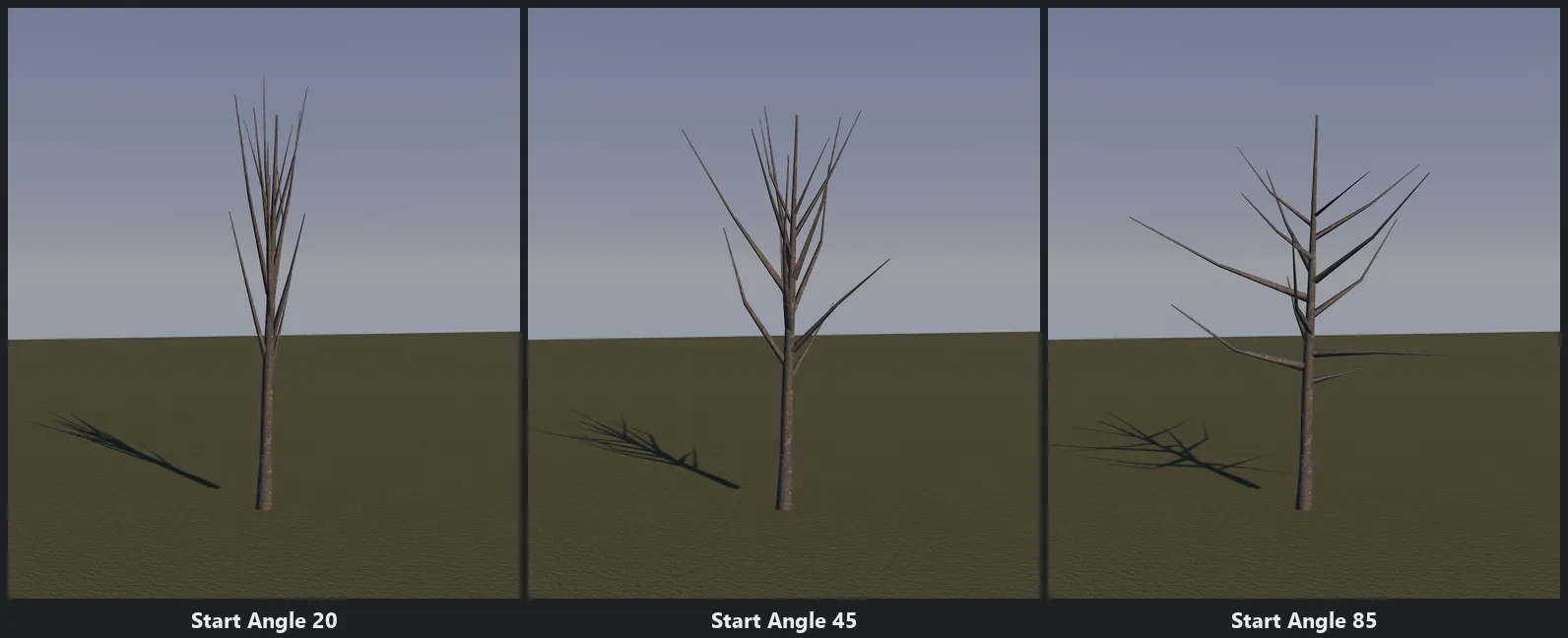
Start Angle is the angle from the parent’s direction: 0 grows along the parent, 90 straight out.
Gravity and Rise
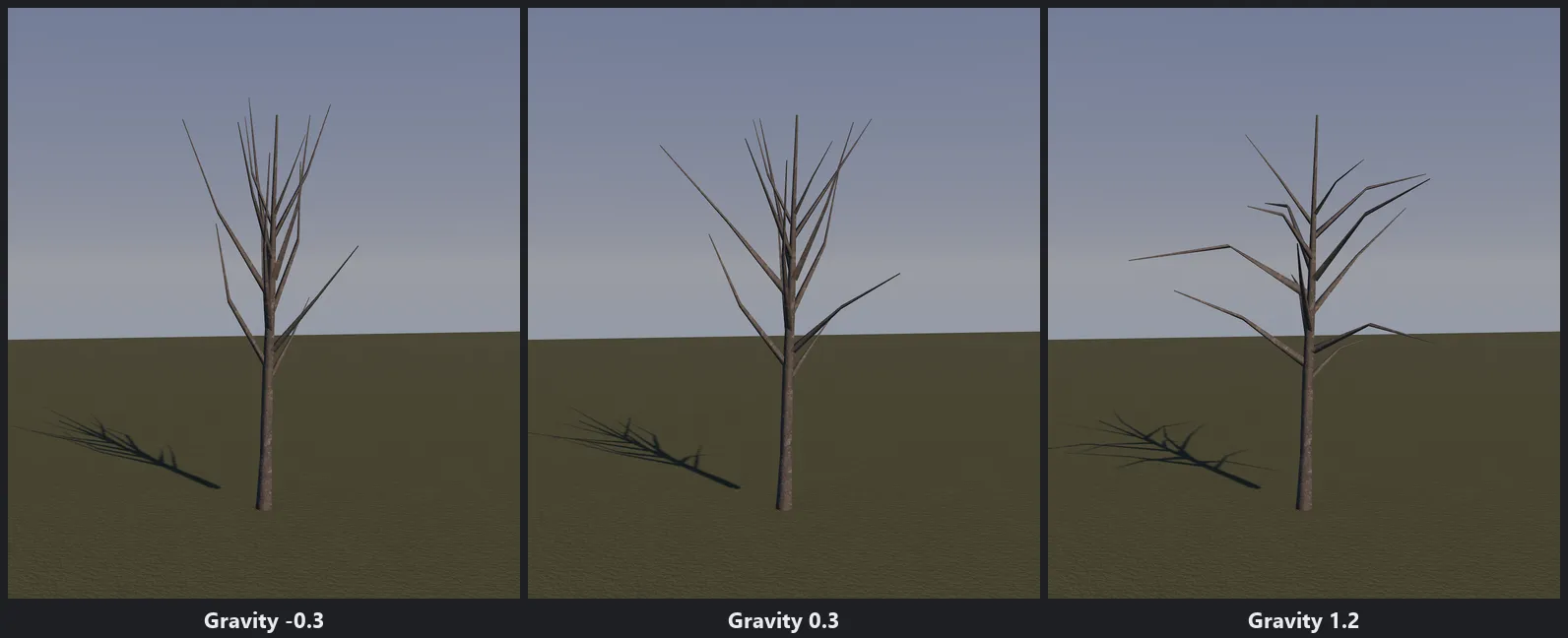
Section titled “Gravity and Rise”Gravity pulls the spine down as it grows (negative values push it up). Rise bends it towards the sky, as shoots seek the light. Both have profile curves: the birch’s boughs only droop in their outer half.
Three kinds of noise make the wood less regular:
- Noise turns the spine at random as it grows. Noise Smoothness decides whether it wanders in long sweeps or twitches.
- Early Noise (SpeedTree’s early noise) turns build up as the spine grows and are let out in one go when they pass Early Threshold. The spine runs straight, then kinks: oak limbs, and the kinks Bifurcation branches from. Early Turbulence sets how quickly the turning changes.
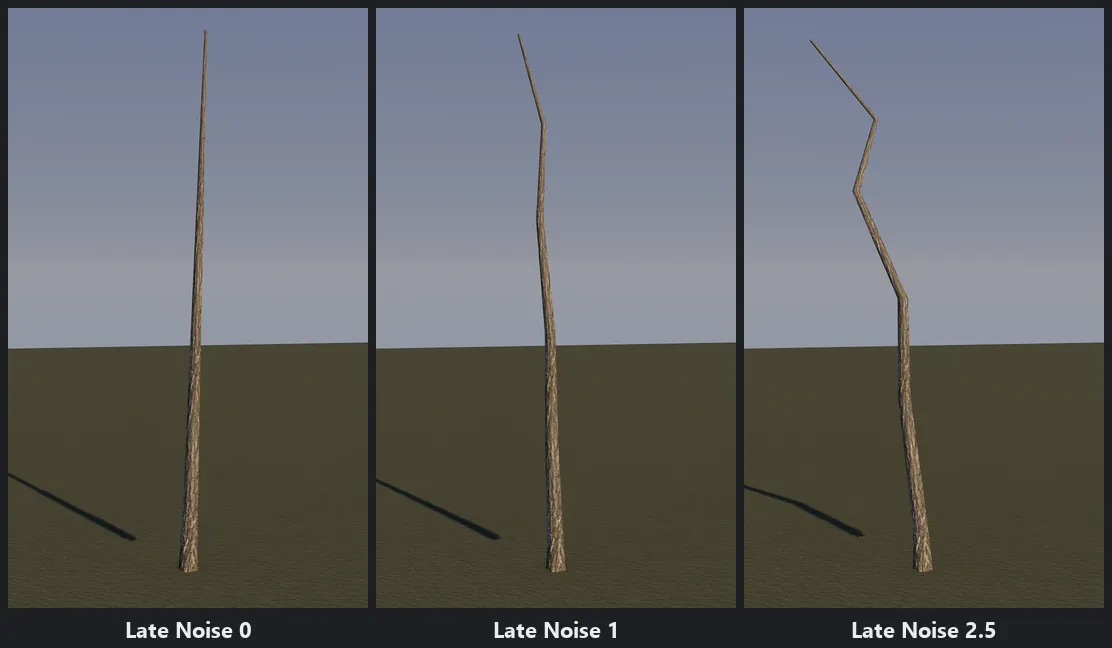
- Late Noise (SpeedTree’s late noise) shifts the finished spine sideways by smooth noise, up to about a tenth of its length. Trunks and limbs become sinuous but still head the same way. Late Turbulence is the number of waves, Late Smooth smooths them.
- Jink adds sudden kinks every few segments.
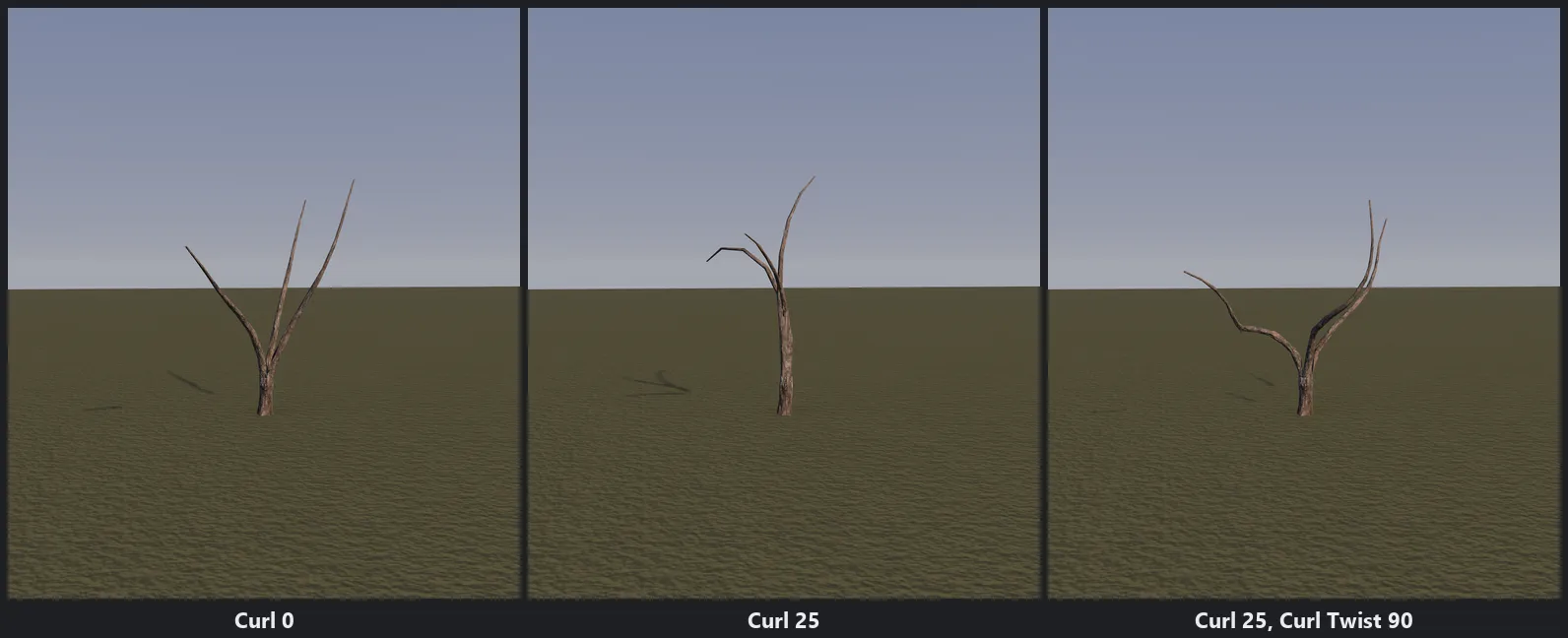
Curl bends the spine steadily to one side (degrees per metre). Curl Twist turns the direction of the curl around the spine as it grows, so it coils into S-curves and corkscrews: twisted juniper stems, vines, sinuous limbs.
Other spine settings
Section titled “Other spine settings”- Force Strength scales how much the tree’s forces bend this generator.
- Break Chance % breaks nodes off part way: storm damage, dead tops.
- Ground Hug keeps the spine near the ground instead of letting it dive in, sinking to Ground Depth by its tip. The Roots type uses it.
Shape Control
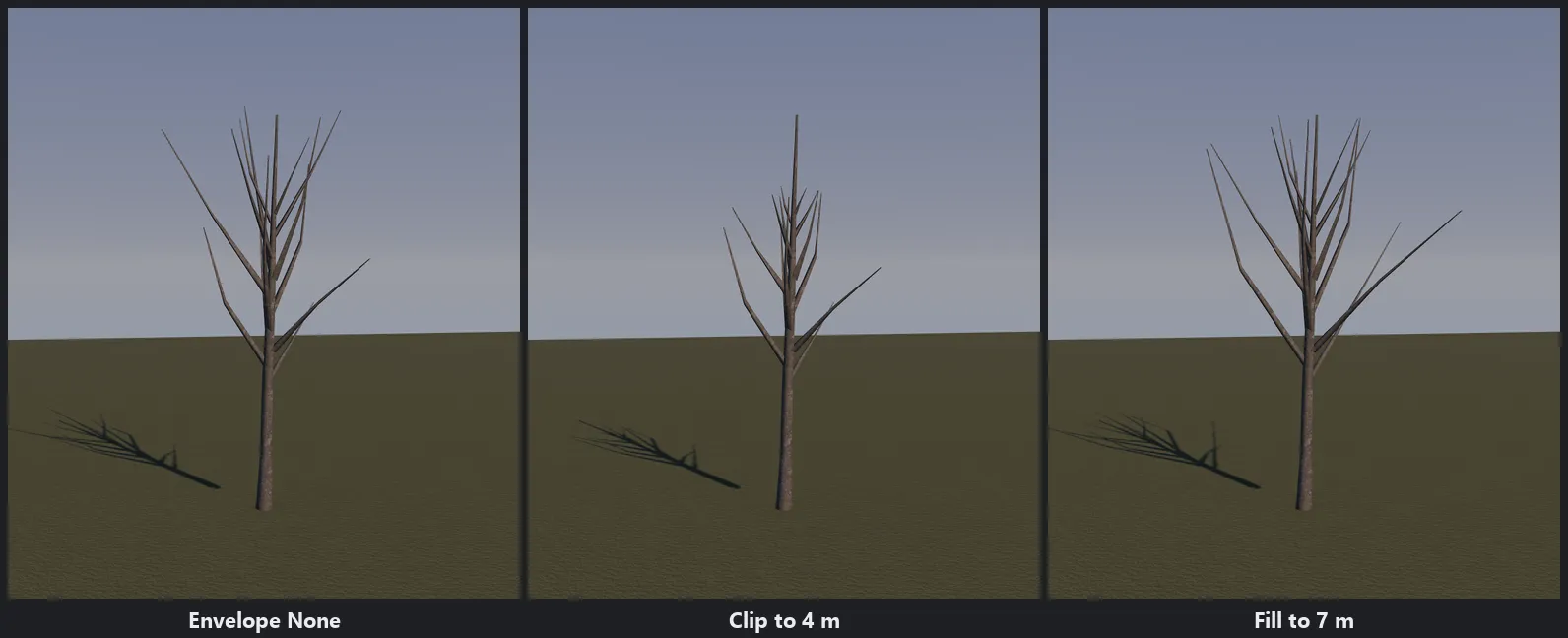
Section titled “Shape Control”An Envelope is an ellipsoid around each parent node (Envelope Size wide, Envelope Height % tall, centred at Envelope Center % of the parent). Clip shortens nodes that reach outside it; Fill also stretches short ones out to it. Use it to give a crown a clean outline.
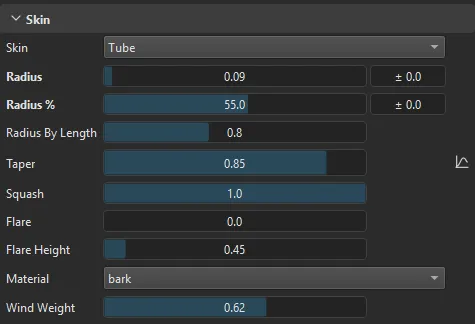
Skin chooses the mesh:
- Tube: bark.
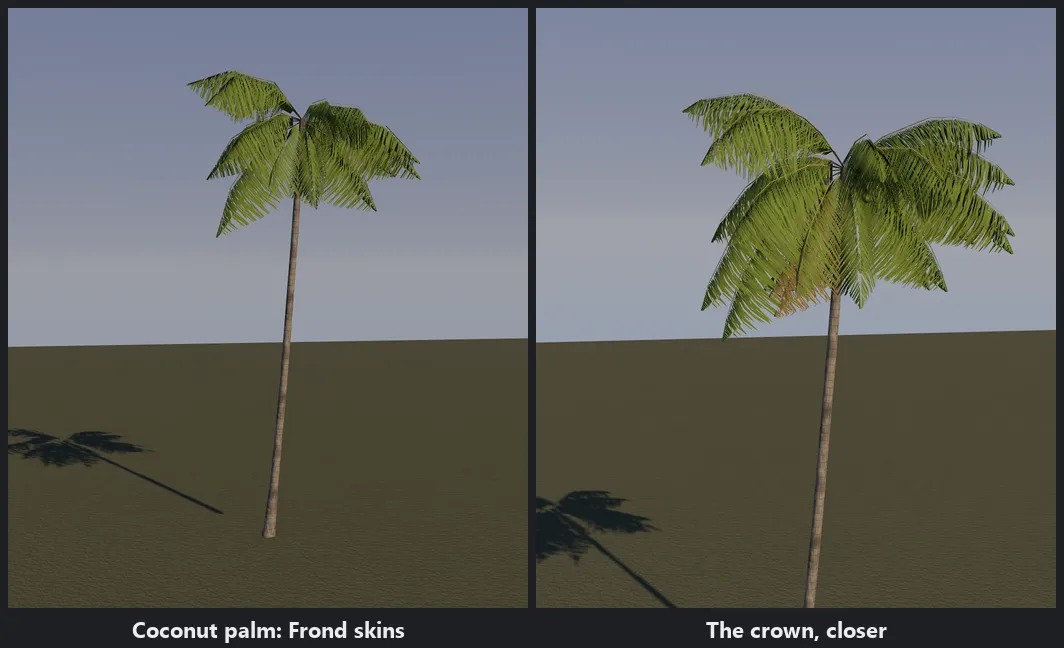
- Frond: a ribbon carrying the material’s whole texture along it (palm fronds, ferns). Frond Width, Frond Fold (a V across) and Frond Droop (the outer half hangs down, like leaflets from a palm’s rachis) shape it.
- Spine Only: no mesh at all. The node only carries its children. Templates use it for the finest twigs, whose detail is painted into the leaf cards.
Radius and taper
Section titled “Radius and taper”- Radius is the base radius in metres, plus Radius % of the parent’s radius where the node starts.
- Radius By Length makes the shorter nodes of a generator thinner.
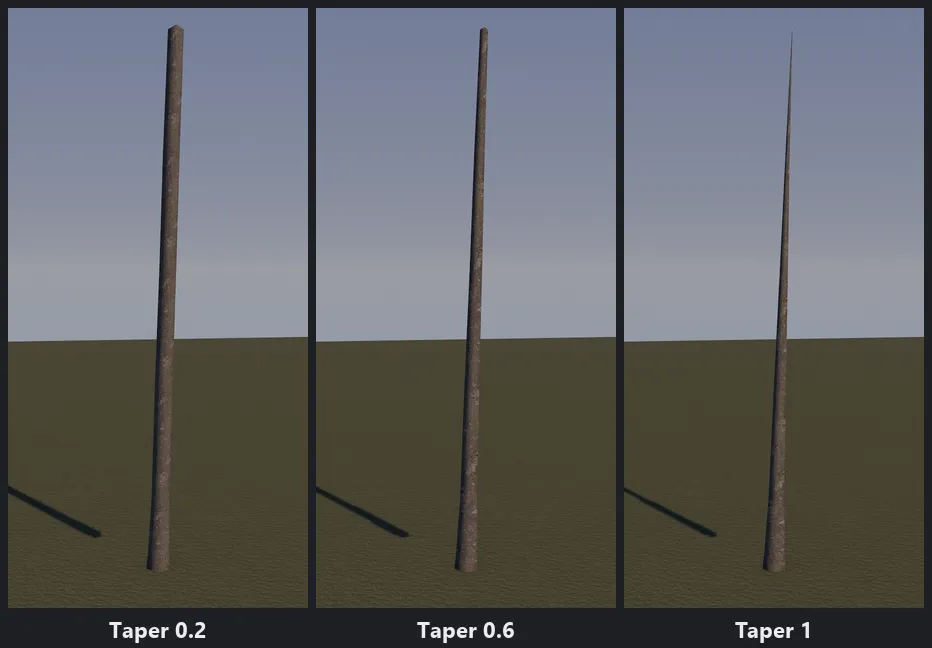
- Taper is the share of the radius lost from base to tip, with a profile curve. Squash flattens the cross-section.
Flare and buttresses
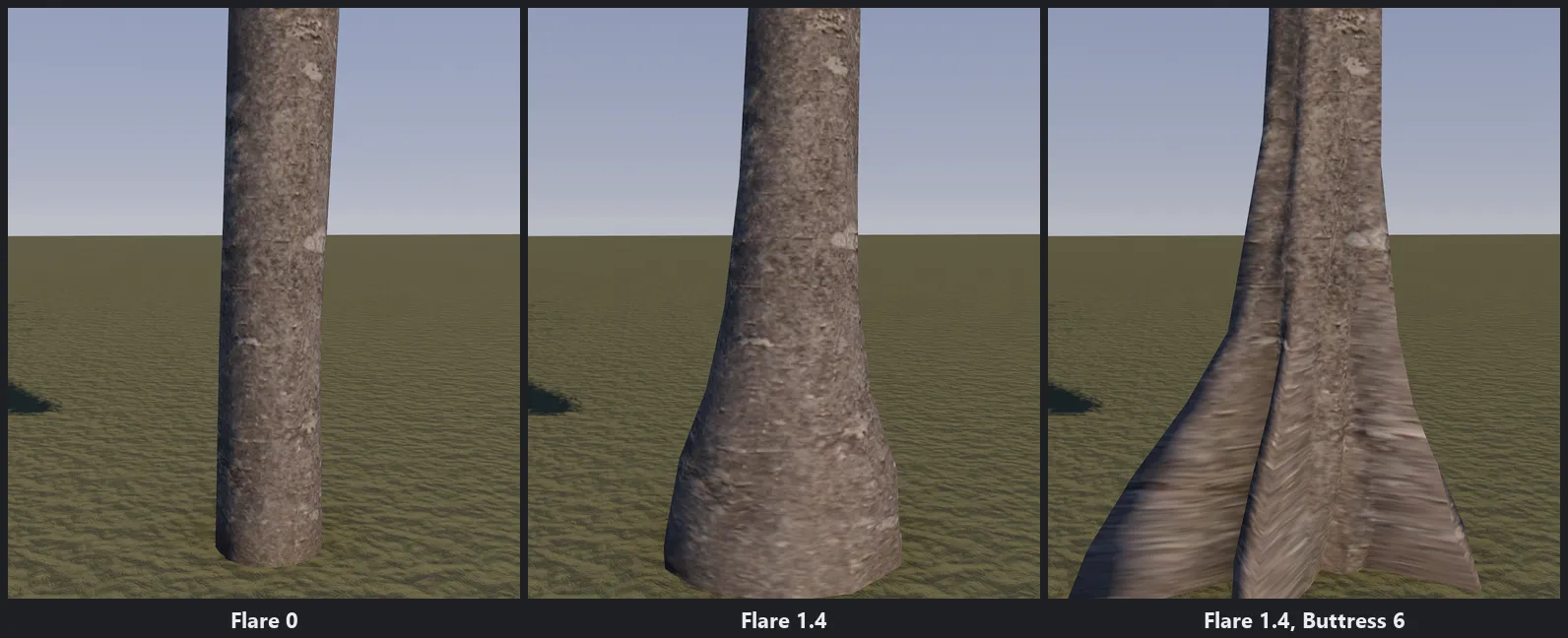
Section titled “Flare and buttresses”Flare adds radius at the base, up to Flare Height metres. Buttress (in Displacement) gathers the flare into that many buttress roots; Buttress Depth is how sharply, Buttress Pinch how narrow each ridge is, and Buttress Jitter makes each one different in angle, size and reach.
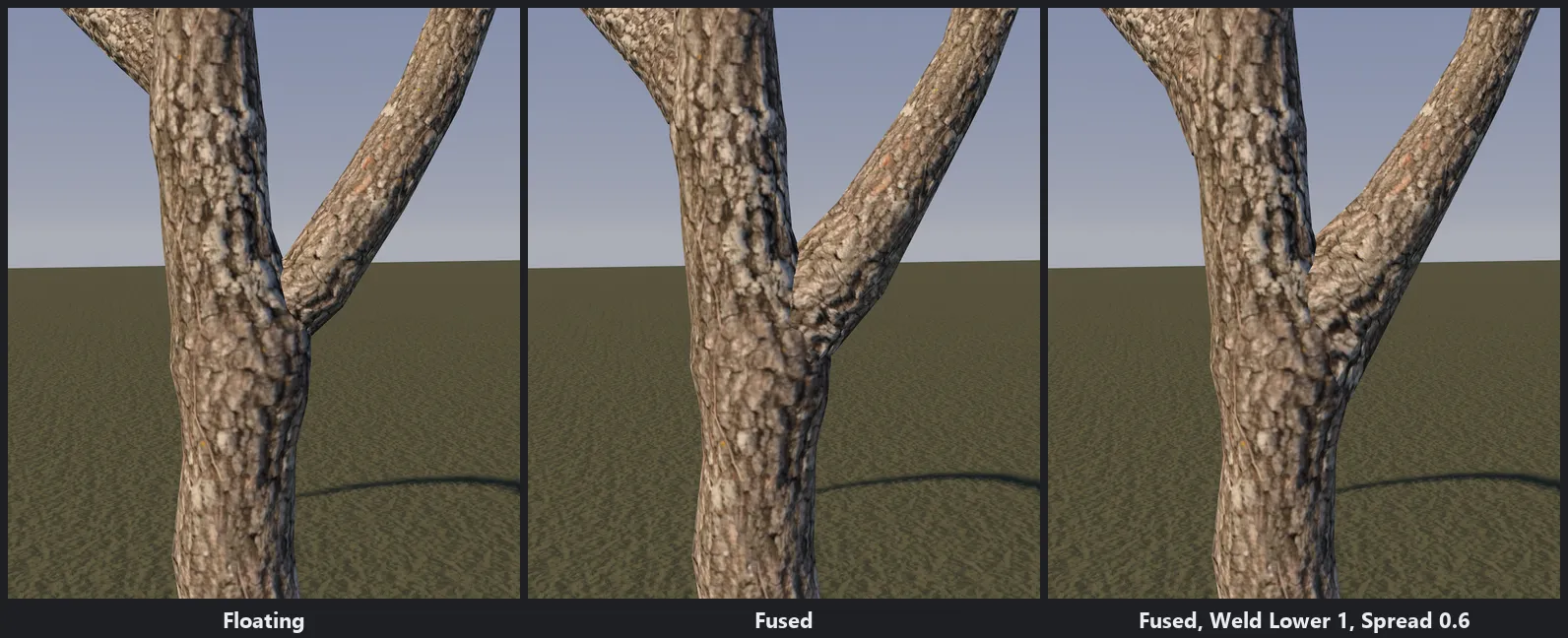
Weld decides how a branch joins its parent:
- Fused (default): the skin starts on the parent’s surface and flares into it like a branch collar, Weld Spread wider over Weld Length times the branch radius.
- Floating: a plain tube starting at the parent’s axis.
Weld Lower and Weld Upper stretch the joint down or up along the parent, as SpeedTree’s welding does: with Weld Lower the bark runs down the trunk below a bough in a teardrop.
Displacement
Section titled “Displacement”Displacement moves the skin in and out to model the wood’s surface. Where a detail level has too few sides to draw a ridge, it fades out instead of flickering.
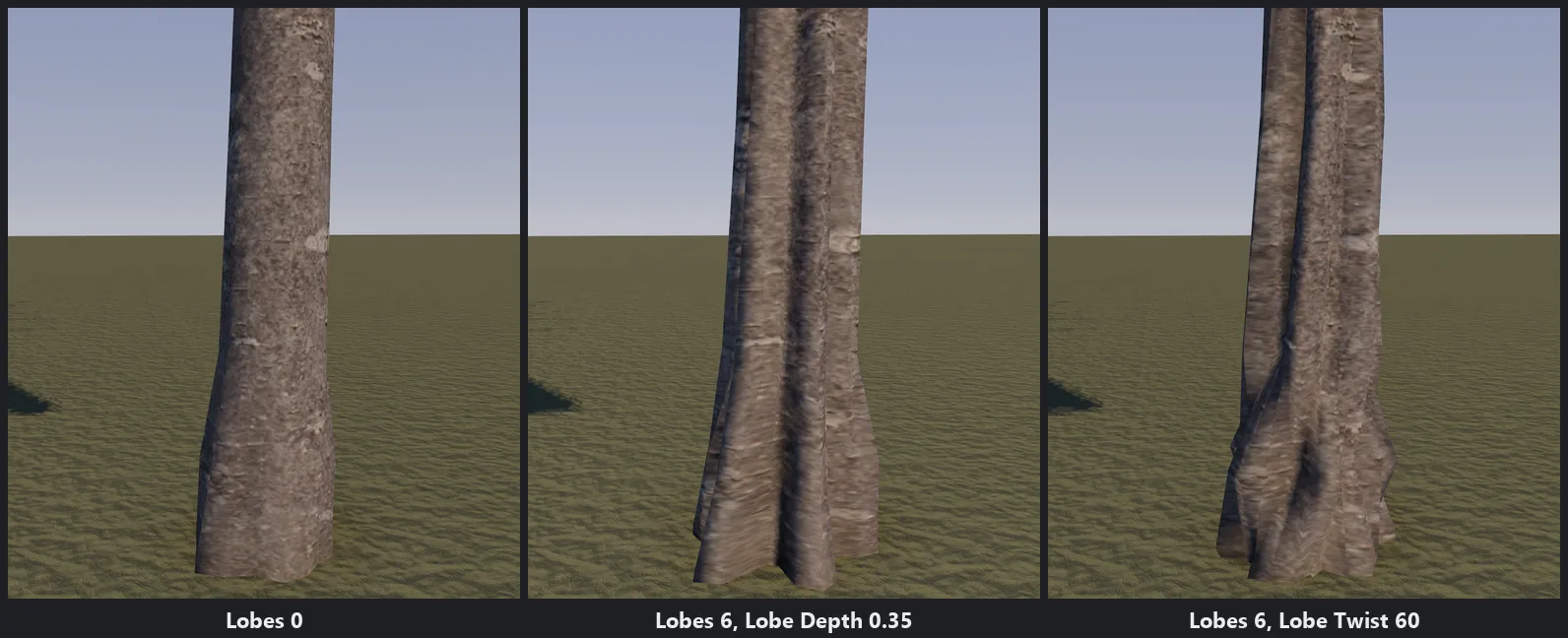
- Lobes are ridges around the skin (fluted trunks), Lobe Depth their height (with a profile curve, so they can fade out up the trunk) and Lobe Twist spirals them.
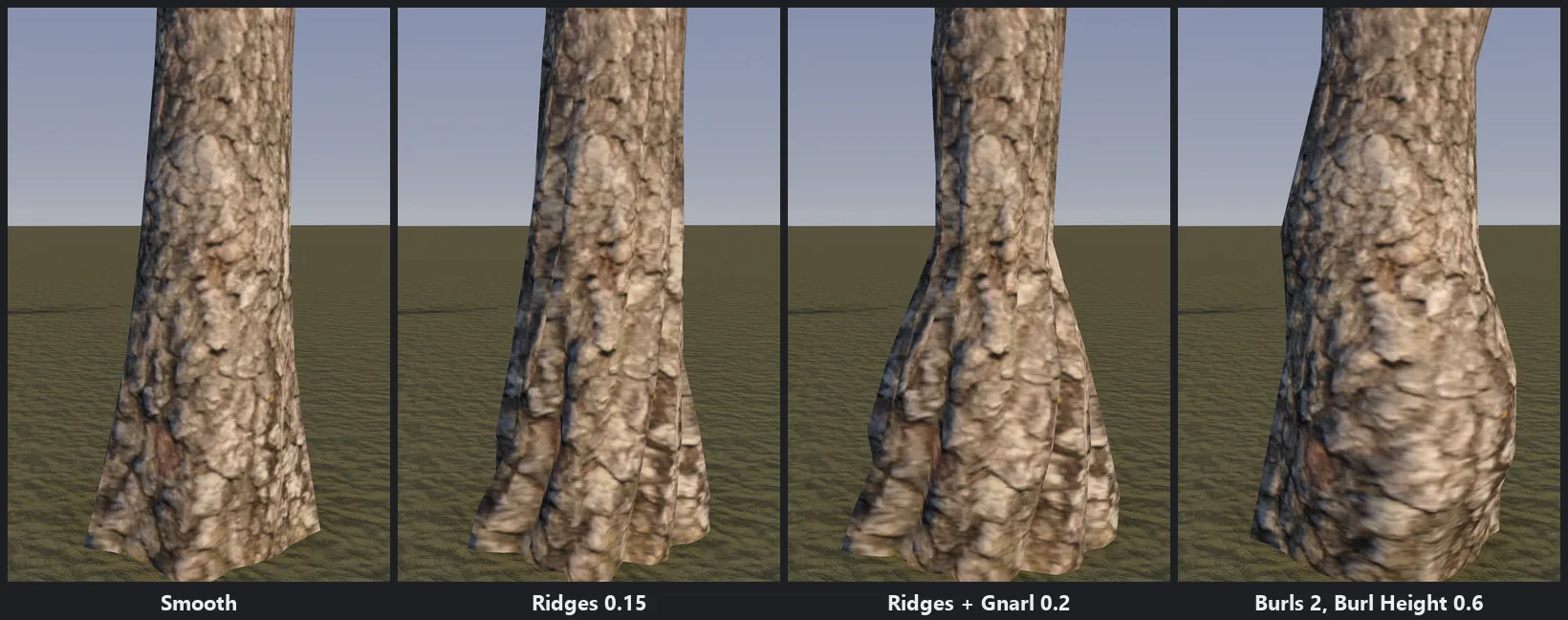
- Roughness adds irregular bumps of Roughness Scale metres. Burls adds swellings (burls, old wounds) per metre, Burl Size wide and Burl Height high.
- Ridges are the bark’s furrows between broad plates, every Ridge Spacing metres around. Ridge Twist gives the grain a spiral, Ridge Wander lets ridges meander, merge and fade.
- Gnarl adds lumps, hollows and twisted bulges that follow the grain, Gnarl Scale long.
- Fork Swell swells the wood where a child branch leaves it; Wrinkles creases the bark in rings around each child’s base.
Texture
Section titled “Texture”- Tile Width is the width of one repeat of the bark texture around the skin, in metres. Thin nodes repeat it fewer times, at least once.
- Tile Aspect is a repeat’s height over its width. 0 takes the texture’s own shape (stock barks are four times taller than wide), so the bark keeps its proportions on thick and thin wood.
- UV Twist spirals the texture; Random Offset shifts each node’s texture so neighbours don’t repeat the same pattern.
Detail Levels
Section titled “Detail Levels”Sides and Segments (and their Mid and Far versions) are the most sides around and segments along a node at each detail level; thin nodes get fewer sides automatically. Min Radius drops nodes thinner than that at near detail, and Mid Keep % / Far Keep % keep only the thickest share of nodes at middle and far detail. The Tree generator’s Mid Min Radius and Far Min Radius apply to the whole tree. See Detail levels.